
Maximum available resources and the right to education
16 July, 2026
The right to education is firmly established in international human rights law (ICESCR 2.1, 1966, Art. 1(1)) and in the constitutions and policies of most countries.
To ensure that every child has the right to education, financing is critical, and as 97% of financing is domestically generated, a focus on national budgets, efficiency, and governance reforms is reasonable. Governments are obligated to use their maximum available resources (MAR) to ensure that education is adequately funded and effectively implemented.
What are the maximum available resources?
Balakrishnan and other experts have stated that MAR depends on five key themes and they provide questions to help assess a government and their partners priorities
(1) government expenditure
(2) government revenue
(3) development assistance (both official development assistance and private resource flows)
(4) debt and deficit financing
(5) monetary policy and financial regulation
The Government Revenue and Development Estimations (GRADE) tool
The Government Revenue and Development Estimations (GRADE) tool can be used to quantify the impact of changes in government revenue. The GRADE tool translates government revenue and spending data into tangible and realistic human impacts and allows policymakers and researchers to see how domestic fiscal choices influence educational inputs, such as the number of teachers and school attendance. In terms of domestic policies, the equivalent amount of money that a government devotes to tax incentives can be translated into the additional number of teachers that money could have funded. This offers a powerful argument for the Ministers of Finance and Education.
Two recent econometric studies underpin the educational component of the GRADE tool. The first study models the effect of an increase in government revenue on school attendance. The size of the increase in attendance was significantly mediated by the quality of governance in the country. The second study models the effect of an increase in government revenue on the supply of teachers and the influence of governance on this effect. Thus, the GRADE tool allows users to model the effect of changes in government revenue on school attendance and teacher supply while factoring in governance quality. This allows for the demonstration of the impact of domestic policy changes or cross-border influences on government resources on school attendance and teacher supply.
Extraterritorial Obligations and Maximum Available Resources
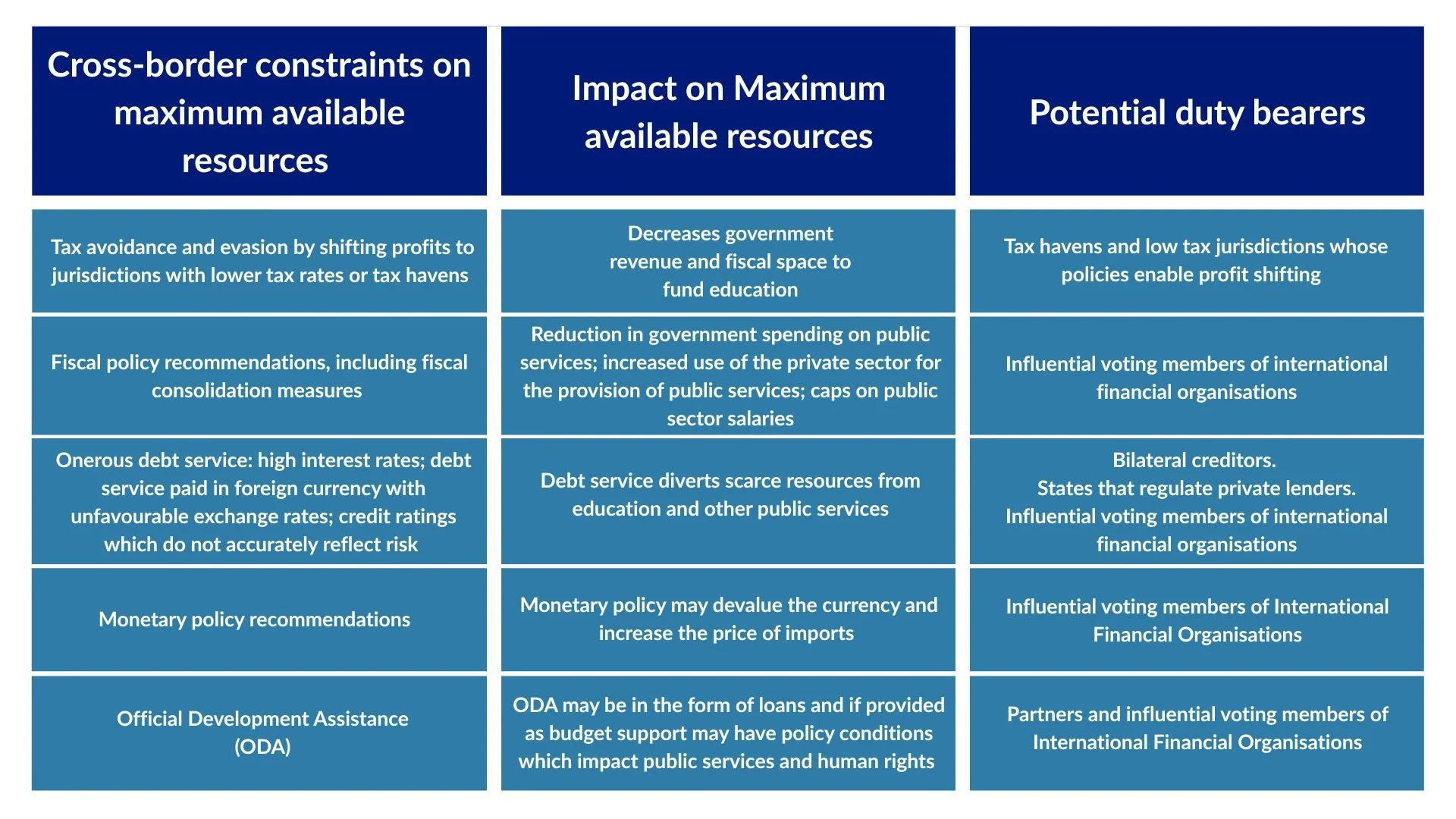
When evaluating MAR for education and analyzing national decisions regarding government revenue generation and allocation, it is important to remember that many governments are hindered from utilizing their MAR due to cross-border policies, practices, and influences. All states have extraterritorial obligations to avoid maintaining arrangements whose cross-border fiscal effects are reasonably foreseeable and significantly impair another state's ability to deploy its maximum available resources to fulfill human rights. Table 1 summarizes some cross-border policies that may impact MAR.
Table 1 Cross-Border Constraints on Maximum Available Resources
Using modelled estimates for advocacy
The insights gained from the GRADE tool can be leveraged by advocates, including teachers' unions, youth groups, and parent-teacher associations, to advocate for changes in domestic policies. By presenting findings—such as the potential number of teachers that could be hired by reallocating revenue equivalent to tax incentives—to their respective ministries, they can push for policy adjustments. Furthermore, the GRADE findings can strengthen advocacy efforts against cross-border policies that infringe on the right to education. To hold states accountable for breaches of extraterritorial obligations, it is crucial to demonstrate that their actions or omissions impede another state's ability to generate or utilize its maximum available resources, resulting in foreseeable rights violations. Modeled estimates using the GRADE tool can effectively highlight these foreseeable rights violations. For instance, by using modeled estimates to illustrate the positive impact of redirecting debt service or other revenue outflows towards funding education and hiring more teachers. These findings can be leveraged both domestically through diplomatic and reputational channels and internationally through submissions to human rights bodies and Special Rapporteurs.
Protecting the right to free, quality public education requires both domestic and extraterritorial policy perspectives that examine how domestic and global financial structures limit countries’ available resources. Econometric modelling enables a shift from abstract claims to empirical analyses of domestic and cross-border violations of children’s educational rights.
Learn more
In April 2026, The Government Revenue and Development Estimation (GRADE) team at the Universities of St Andrews and Leicester along with Center for Economic and Social Rights (CESR) and The Grown too Quick Foundation (GTQF) produced a short joint submission to the UN Special Rapporteur on the Right to Education’s call for contributions on International financial architecture, debt and the right to education. The submission is available here and includes estimates of the potential impact on the right to education of cancelling external debt.
A group of PEHRC members also submitted a submission to the same call for inputs from the UN Special Rapporteur on the Right to Education. Drawing on evidence from across the world, the group of civil society organisations called for: reforms to international debt governance and macroeconomic policy frameworks so that States can fulfil their right to education obligations; a shift from austerity-driven approaches, which undermine public education systems, to the viable alternatives, and progressive and equitable resource mobilisation. The submission is available here.
The Global Initiative for Economic Social and Cultural Rights, a PEHRC member, has recently used the GRADE tool to understand how austerity and debt are influencing social and human rights in Kenya and Ghana. The reports are available here.
Authors
Mada D. Nkhoma, Research Assistant with the GRADE team, at the Universities of St Andrews and Leicester.
Bernadette O’Hare, Reader in Global Health, the University of St Andrews
Stephen Hall, Professor of Econometrics, University of Leicester
Views expressed in this blog are those of the author/s’ alone. Publication on this blog does not represent an endorsement by PEHRC of the opinions expressed.